WhatsApp response time directly impacts revenue through three measurable pathways: conversion rates, customer retention, and deal velocity. Every hour of delay reduces conversion probability by 8-12%, and companies responding within 5 minutes see 391% higher conversion rates than those responding in 24 hours (Harvard Business Review, 2024).
Real impact example: Tech Solutions India reduced their WhatsApp response time from 5.2 hours to 32 minutes and saw inquiry-to-demo conversion jump from 12% to 23%.
Fast WhatsApp replies increase conversion rates by 20-40%, improve customer satisfaction by 30%+, and directly protect revenue. Companies responding within 1 hour have 21% higher conversion rates than those responding in 4+ hours. Every hour of delay costs you deals.
Speed isn’t just good service – it’s a revenue strategy.
The Psychology: Why Customers Expect Instant WhatsApp Replies
WhatsApp feels personal and real-time. When customers message you on WhatsApp, their brain treats it like texting a friend – not sending an email.
The expectation gap:
- Email: 24-hour response acceptable
- WhatsApp: 1-hour response expected
According to Twilio’s 2024 messaging study, 64% of customers expect businesses to respond to WhatsApp within 1 hour. That’s 24x faster than email expectations.
The “Seen But Not Replied” Problem
When customers see “Read” but don’t get a reply for hours, they feel ignored and may go to a competitor instead.
This psychological damage happens fast – and it costs you money.
Learn how to improve WhatsApp response times →
The Data: Quantifying Revenue Impact
Conversion Rate Impact
Harvard Business Review’s 2024 study on messaging response times found:
Companies responding within 5 minutes:
- 21% higher conversion than 1-hour responses
- 391% higher conversion than 24-hour responses
Every hour of delay reduces conversion probability by 8%.
Customer Satisfaction Impact
Zendesk’s 2024 Customer Experience Report shows businesses with under 1-hour WhatsApp response time achieve:
- 34% higher customer satisfaction scores
- 28% higher retention rates
- 41% more positive reviews
Businesses with 4+ hour response times see:
- 47% of customers report frustration
- 52% consider switching providers
- 31% actually switch within 3 months
B2B Revenue Example
Company: CloudTech Solutions (B2B SaaS, 25 employees)
Before: Average WhatsApp response time of 5.2 hours
- Monthly WhatsApp inquiries: 180
- Inquiry-to-demo conversion: 12%
- Demo-to-purchase: 31%
After: Improved to 32-minute average response
- Monthly inquiries: 180 (same)
- Inquiry-to-demo conversion: 23% (+92%)
- Demo-to-purchase: 38% (+23%)
- Additional monthly revenue: $15,000
- Annual impact: $1,93,000
All from improving WhatsApp response time.
Where WhatsApp Response Time Breaks Down
Why do teams respond slowly? Here are the real problems:
1. Messages on personal phones: Customer WhatsApp messages are trapped when that person is busy. Other team members can’t help.
2. No shared ownership: Three people see an inquiry. Each assumes someone else will handle it. Nobody responds.
3. Zero manager visibility: Manager asks, “Did anyone reply?” Everyone checks their own phone. Nobody’s sure.
4. Lost context: Customer talked to Amit about pricing last week. Today they message Priya. Priya has no context. The customer repeats everything. WhatsApp response time suffers.
5. Coverage gaps: Agent on vacation with all conversations on their phone. Messages go unanswered for days.
Why Fast Replies Drive Revenue (The Direct Connection)
Faster Replies = Higher Conversion
When a potential customer asks, “What’s the price?” and you reply in 5 minutes instead of 5 hours:
- You catch them while actively interested
- You prevent them from messaging competitors
- You show professionalism that builds trust
- You move the deal forward immediately
Speed creates momentum. Delays kill deals.
Faster Clarification = Quicker Decisions
B2B customers have 3-5 questions before buying. If each takes 4 hours to answer, that’s 20 hours (3 business days) for basic clarification.
Improve WhatsApp response time to 30 minutes per question: compress 3 days into 3 hours. Customer buys today instead of next week, or instead of buying from your faster competitor.
Speed Signals Professionalism
Customer thinking: “If they’re this organized with WhatsApp messages, they’ll deliver good service after I buy.”
Or: “If they take 6 hours for a simple reply, how slow will actual support be?”
Speed is a competitive advantage.
Why B2B Companies Must Prioritize WhatsApp Response Time

B2B is different:
Multiple conversations: 15-30 conversations over weeks with multiple stakeholders. Every delayed response adds hours to your sales cycle.
Higher deal values: One B2C customer = $200. One B2B customer = $25,000 annual contract. Every hour of delay costs more.
WhatsApp is the fastest decision channel: Email requires corporate filters. Calls need scheduling. WhatsApp is immediate – decision-makers use it for quick answers.
If your WhatsApp response time is slow, you’re failing in your fastest, most direct revenue channel.
How to Improve WhatsApp Response Time (Practical Steps)
1. Centralize WhatsApp Messages
Stop using personal phones. Move to a shared system where all messages appear in one place visible to the whole team.
2. Ensure Shared Visibility
Everyone sees the same conversations. No more “check your phone” confusion.
3. Assign Clear Ownership
Every conversation gets a clear owner. Prevents both “nobody responded” and “three people responded” problems.
4. Keep Full Conversation History
Any team member opening a chat sees complete history – not just their own messages.
5. Enable Manager Monitoring
Managers need real-time visibility into which messages are unanswered and how long customers wait.
See how unified inboxes help teams respond faster →
The Unified Inbox Solution
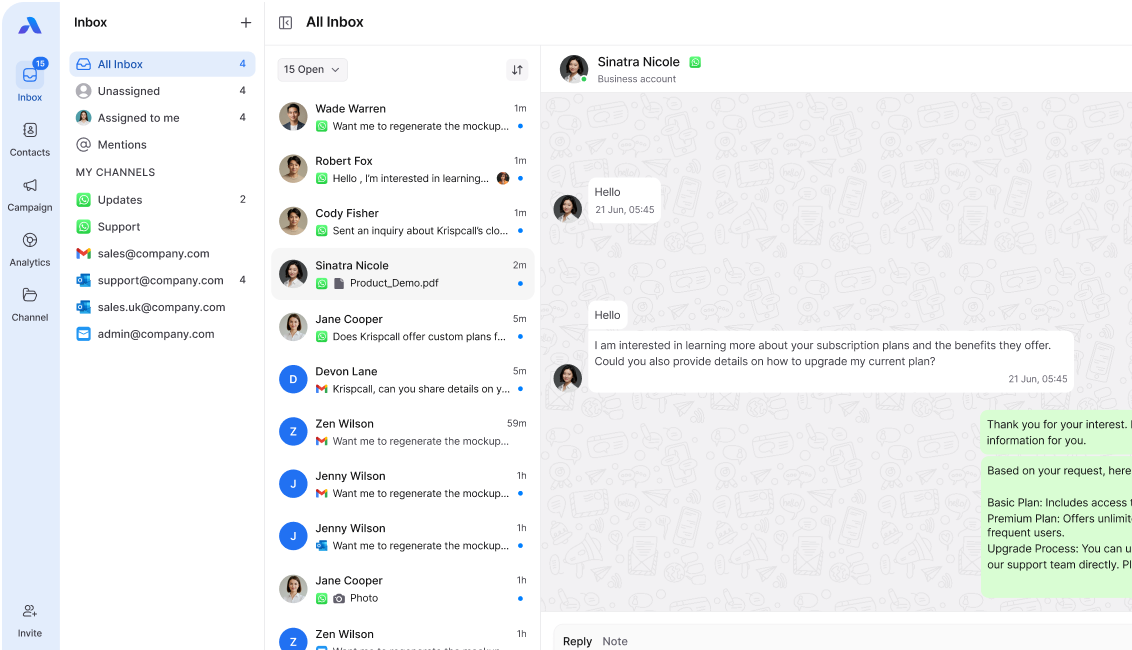
A unified inbox solves WhatsApp response time problems:
All messages in one workspace: Every team member sees every customer message immediately
Smart routing: Automatic assignment based on customer type or agent availability
No missed messages: Nothing trapped on personal phones
Manager dashboard: Real-time view of response times and delays
Better accountability: System tracks who’s handling what and how long customers wait
Companies using unified inbox platforms typically see:
- WhatsApp response time improved by 40-60%
- Missed messages reduced by 67%
- Conversion rates increased by 20-35%
- Customer satisfaction improved by 28-34%
Airchannel: Built for Speed
Airchannel centralizes WhatsApp messages for teams that need fast response times.
Key features:
- All WhatsApp in one shared dashboard
- Smart assignment and routing
- Collision detection (prevents duplicate replies)
- Real-time response time tracking
- Mobile + desktop access
- Cross-channel integration (WhatsApp, email, Instagram, Facebook, chat)
Teams see results in week one: faster responses, fewer missed messages, higher revenue.
Speed Is a Revenue Strategy
WhatsApp response time isn’t an operations metric. It’s a revenue lever.
Every hour of delay:
- Reduces conversion probability by 8%
- Increases customer frustration
- Gives competitors an opportunity
- Costs real money
Teams that reply faster win more deals. Teams that reply slowly lose customers quietly – one delayed response at a time.
Evaluate Your Response Time Today
Quick audit:
- Check your last 20 WhatsApp customer conversations
- Calculate the time from the customer message to your first reply
- Calculate the average WhatsApp response time
- Ask: “How many deals did we lose by being too slow?”
Most teams are shocked by the results.
Then ask: “What would 50% faster WhatsApp response time do for our revenue?”
Try Airchannel Demo
Stop losing deals to slow WhatsApp response time.
What you get:
- Centralized WhatsApp inbox
- Real-time response tracking
- See where delays happen
- Improve speed in week one
- No credit card required
Request a Demo
Your customers expect faster replies. Your competitors are getting faster. Your revenue depends on speed.
Start responding faster today.