The Problem With Most Customer Communication
Most businesses wait for customers to reach out first. A problem shows up. The customer complains. The business responds. That cycle is expensive, slow, and frustrating for everyone involved.
How to communicate with your customers effectively in 2026 requires a move from reactive support to proactive engagement. By following a 5-step strategy, choosing the right channels, defining your brand voice, batching questions, leveraging AI automation, and measuring CSAT, businesses can build trust and reduce churn. In this guide, we break down the modern blueprint for customer communication.
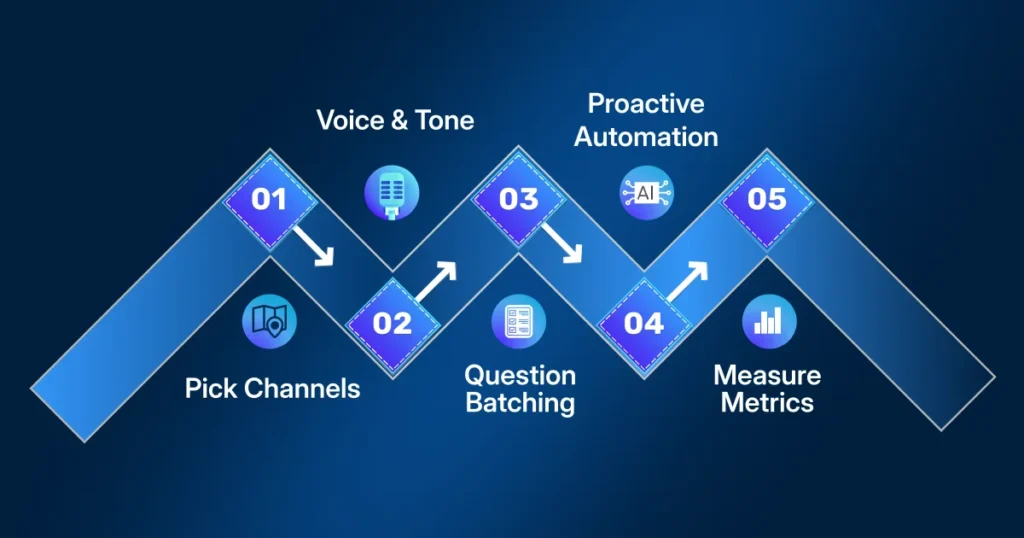
This guide gives you a clear five-step strategy to do exactly that in 2026. No jargon. No fluff. Just a practical playbook you can start using this week.
Why This Matters More Than Ever in 2026
Customer expectations have shifted. People no longer accept “we will get back to you in 3 to 5 business days.” They want fast answers, clear communication, and zero repetition.
A 2024 Salesforce report found that 88 percent of customers say the experience a company provides is just as important as its product. That number keeps climbing.
The good news is that knowing how to communicate with your customers well is a skill. It can be built, measured, and improved. The five steps below show you how.
Step 1: Choose the Right Channels First
You cannot communicate well if you are on the wrong platform. Sending a detailed policy update over SMS is just as bad as sending a quick order alert through a ten-paragraph email.
Every channel has a job. SMS is for short, urgent updates. Email handles detail and documentation. WhatsApp works for global customers who want fast, casual replies. Live chat converts buyers who have questions mid-purchase. Video calls build trust with high-value clients.
The mistake most businesses make is picking channels based on what is easiest for them, not what works best for their customers. Start by asking where your customers already spend time. Meet them there.
A few questions to guide your channel selection:
- Is this message urgent or informational?
- Does the customer need to reply or just read?
- Is this a one-time message or part of an ongoing conversation?
Once you have your channels mapped, your message quality improves automatically because you are no longer forcing the wrong format.
For a full breakdown of every major channel, response time benchmarks, and how to build an omnichannel stack, read our complete guide to customer communication channels.
Step 2: Get Your Voice and Tone Right
Channel selection tells you where to talk. Voice and tone tell you how to talk.
Your voice is your brand personality. It stays the same across every channel. Friendly, direct, helpful. That voice should sound the same whether a customer gets an SMS from you or sits on a weekly video call with your account team.
Tone shifts based on the situation. A loyalty reward message is upbeat. A payment failure notice is calm and reassuring. A complaint response is empathetic first, solution-focused second.
Here is a simple rule: write the way a knowledgeable friend would talk, not the way a legal document reads.
Bad tone example: “We regret to inform you that your order has experienced an unexpected delay in our fulfillment process.”
Better tone example: “Your order is running late. We are sorry. Here is your new delivery date and what we are doing to fix it.”
Same information. Completely different experience.
Before you send any message, run it through the 5 C’s: Clarity, Concision, Confidence, Consistency, and Compassion. If it passes all five, send it. If it fails one, rewrite it.
For 15 copy-paste templates covering real scenarios from welcome emails to AI handoffs, visit our guide on customer communication examples.
Step 3: How to Communicate with Your Customers Without Overwhelming Them
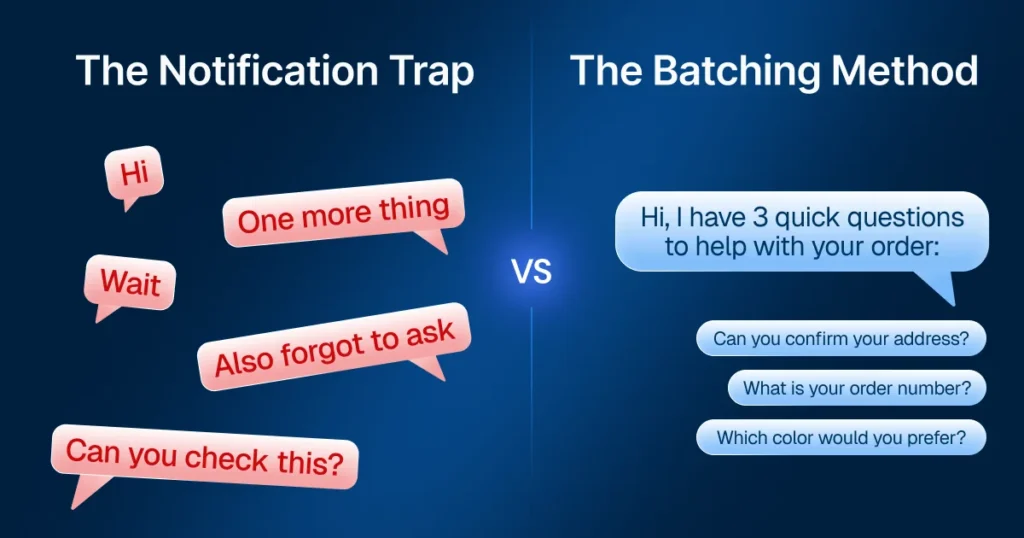
This tip comes up constantly in customer success communities, and it works.
Most teams send messages the moment a question comes up. A customer calls. The agent asks one question. The answer arrives. Another question appears. Another message goes out. By the end of the day, the customer has received five separate pings, feels hounded, and starts ignoring your messages.
Question batching solves this. Instead of sending five small messages throughout the day, you collect all your open questions and send one structured message with everything in it.
Here is what a batched message looks like:
“Hi [First Name], I have a few quick things to check with you before we move forward.
- Can you confirm the delivery address is still [Address]?
- Did you receive the onboarding document we sent on Monday?
- Are you happy to lock in [Date] for our next call?
Reply to all three when you get a chance. No rush.”
This approach does four things well. It respects the customer’s time. It reduces notification fatigue. It speeds up your internal process because you get all the answers at once. And it signals that your team is organized and thoughtful.
A good rule of thumb is to batch questions once per communication window. Morning and the end of the day are the two most effective times. If something is genuinely urgent, that is the only exception for a standalone message.
Knowing how to communicate with your customers without overwhelming them is just as important as knowing what to say.
Step 4: How to Communicate with Your Customers Using AI and Automation
Reactive communication is waiting for the customer to raise a problem. Proactive communication is reaching out before they even realize there is one.
The difference in customer experience is enormous. And in 2026, AI makes proactive communication achievable even for small teams.
Airchannel.ai is built specifically for this. It helps businesses automate the right messages at the right moments while keeping every interaction feeling personal.
Here is how it works in practice:
A customer’s payment fails. Instead of waiting for them to notice and contact support, Airchannel.ai fires an automatic SMS within minutes: calm in tone, clear on next steps, with a one-click fix link included.
A customer’s order is delayed. Before the customer checks their tracking and feels frustrated, Airchannel.ai sends a proactive update with a new delivery date and an apology.
A high-value client has not logged in for two weeks. Airchannel.ai flags this and prompts the account manager to send a check-in message before churn becomes a risk.
The Human-in-the-Loop Model
Full automation without human oversight is a risk. Airchannel.ai uses what is called a human-in-the-loop model. This means AI handles the volume and speed while a human agent reviews, approves, or overrides messages in sensitive situations.
For example, a bot can handle an order status question without any human involvement. But if the conversation shifts to a complaint, a refund dispute, or anything emotionally charged, the system flags it for a human agent. That agent steps in with full conversation history already loaded, so the customer never has to repeat themselves.
This model lets small teams operate at the speed and scale of a much larger operation. It answers the core question of how to communicate with your customers efficiently without sacrificing quality.
Step 5: Measure What Actually Matters
You cannot improve what you do not track. Most businesses collect too much data and act on none of it. Focus on three metrics that directly reflect communication quality.
CSAT (Customer Satisfaction Score) This is collected right after an interaction. You ask the customer one simple question: “How satisfied were you with this experience?” Scored on a scale of 1 to 5. Anything below 4 is worth investigating immediately. CSAT tells you how individual interactions are landing.
FRT (First Response Time) This measures how long it takes your team to send the first reply after a customer reaches out. Industry benchmarks by channel: under 60 seconds for live chat, under one hour for social media, under four hours for email. FRT is one of the fastest ways to see whether your team is set up for speed or stuck in bottlenecks.
Churn Rate Churn tells you the percentage of customers who stopped doing business with you in a given period. Poor communication is one of the top three reasons customers leave. If your churn rate is climbing, go back to Step 1 and audit your channels and message quality before assuming it is a product problem.
Track these three metrics monthly. Set a baseline in month one. Set a target for month three. Review and adjust.
Reactive vs. Proactive Communication: A Direct Comparison
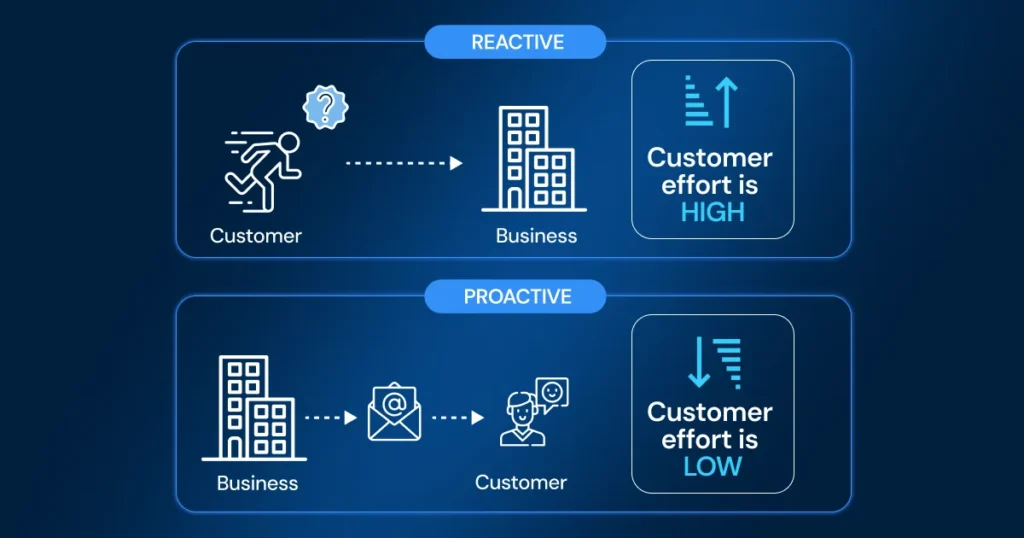
Understanding how to communicate with your customers means knowing the difference between reacting and anticipating.
| Factor | Reactive Communication | Proactive Communication |
| Trigger | Customer contacts you first | You reach out before the customer notices a problem |
| Customer effort | High (they have to chase you) | Low (the answer arrives before the question) |
| Trust impact | Neutral at best, damaging at worst | Builds confidence and loyalty |
| Team workload | High volume of inbound queries | Lower inbound volume, more controlled outreach |
| Example | Customer emails asking where their order is | You text the customer before they check tracking |
| Cost | Higher (more tickets, more agents needed) | Lower (automation handles the early touchpoints) |
| CSAT outcome | Often lower due to frustration | Consistently higher |
| Churn risk | Higher when issues go unaddressed | Lower because problems are caught early |
The shift from reactive to proactive is not instant. Start with your two or three most common inbound query types. Build a proactive message for each one. Automate the delivery. Measure the drop in inbound tickets. Then expand from there.
Final Thoughts
Knowing how to communicate with your customers is not a soft skill. It is a business strategy with measurable results.
You now have the five steps. Choose the right channels. Nail your voice and tone. Batch your questions. Use AI to stay proactive. And track the three metrics that tell you whether it is working.
None of this requires a big team or a big budget. It requires intention, the right tools, and a commitment to treating every message as a chance to build trust.
Start with one step this week. Pick the one that feels most broken in your current process. Fix that first. Then move to the next.
Your customers will notice before you even have to tell them something has changed.
Tired of the “Notification Trap”?
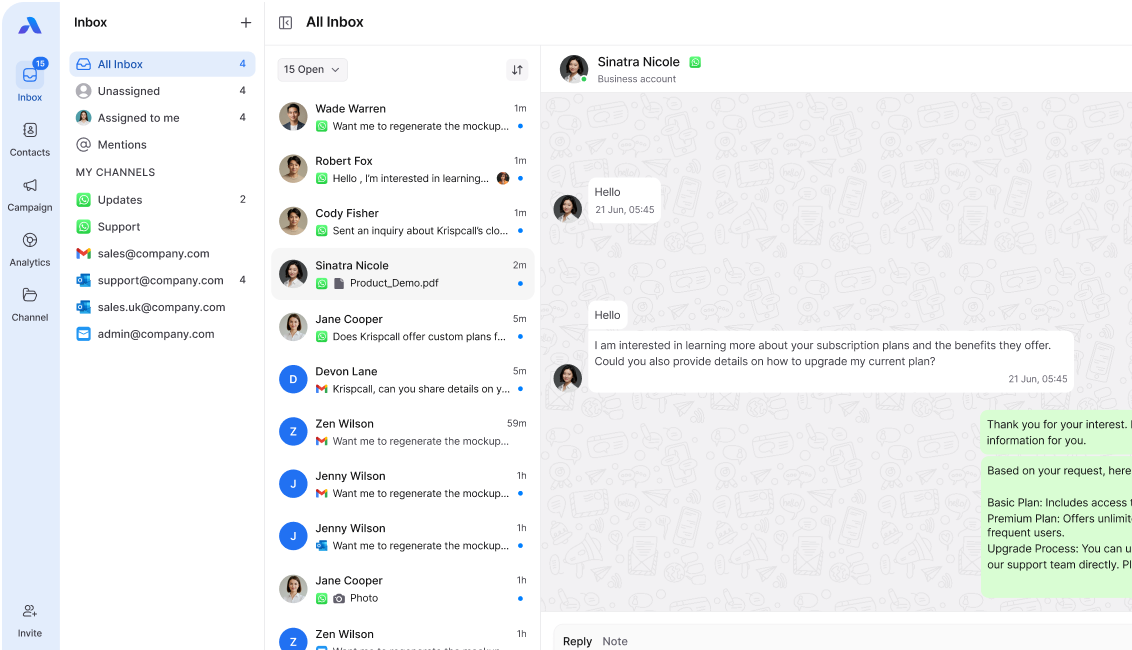
Don’t annoy your customers with 10 pings a day. Use Airchannel’s Unified Inbox to organize your messages, batch your questions, and respect your customers’ time.
Request a Demo