Why Customer Conversations Are the New Business Infrastructure
The truth is, today and every day, your business is based on conversations, not transactions. Every day, your customers are communicating with you. The way you respond to these conversations is what will give you market share or put you behind the competition.
Customer conversation management has become as critical as managing your finances or inventory. Why? Customers want quick answers on every app, and this affects their experience with your company from start to finish.
Conversations now happen across:
● Email for detailed inquiries
● WhatsApp for quick questions
● Live chats on your website
● Social media comments and messages
● Phone calls and video meetings
Salesforce’s 2024 report says 78% of customers want the same experience on all channels.
Yet most businesses still manage conversations in scattered, disconnected ways.
The real challenge isn’t volume – it’s management. When messages are spread across different tools, devices, and team members, you lose track of things. Deals get missed. Customers have to repeat themselves. They focus on coordination rather than assistance, making customers feel as if they are not being heard or matter at all.
Customer conversation management is more than a software solution; it is a system that helps teams manage messages and delight customers.
It allows all messages to be stored in one place, sent to the right person, and tracks the status. Without it, teams take a long time to respond, lose business, offer poor customer experiences, and waste time.
With it, teams reply faster, make customers happier, and understand their needs to protect revenue.
What Is Customer Conversation Management?

Customer conversation management helps businesses manage customer messages quickly and properly.
Specifically, it helps teams:
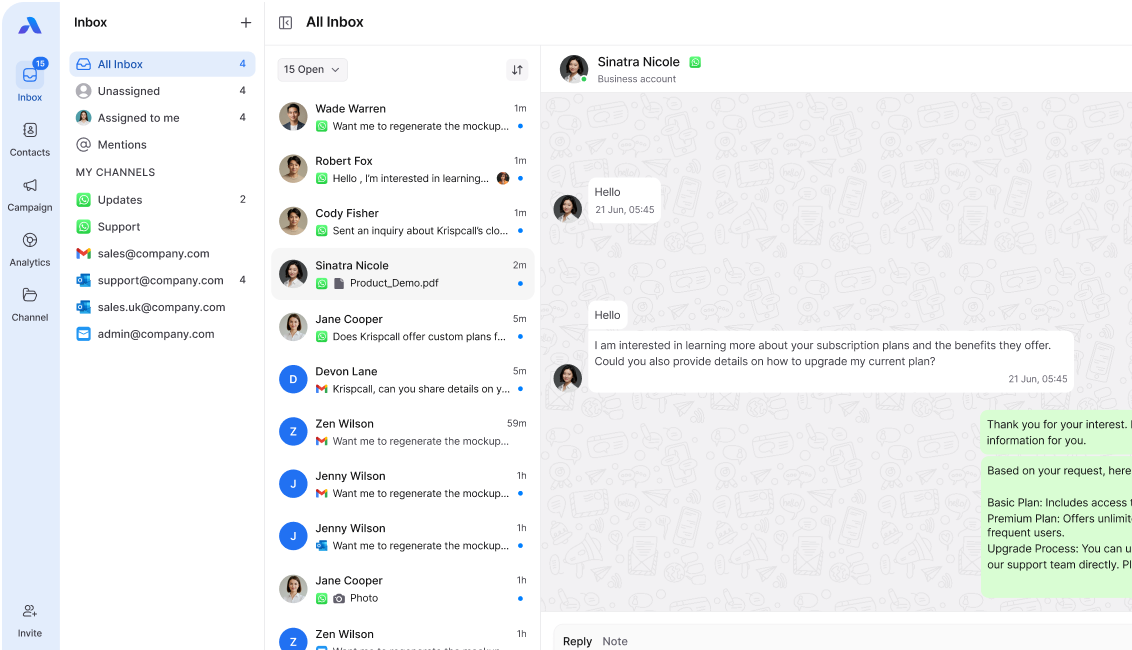
● Centralize all conversations in one workspace
● Assign conversations to the right people
● Track response times and resolution rates
● Collaborate internally without the customer seeing coordination
● Measure team performance and customer satisfaction
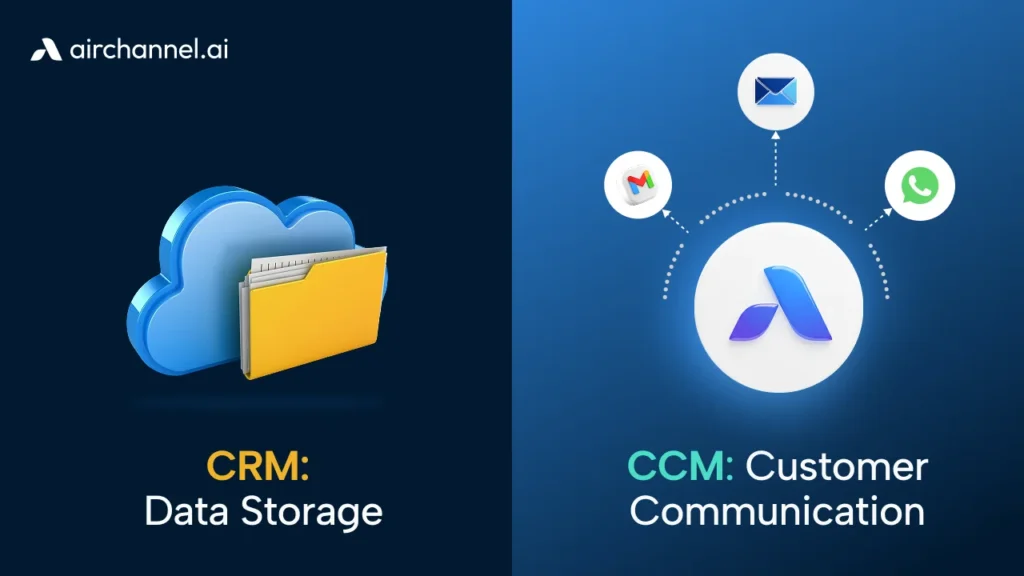
CRM keeps track of customer information and deals. Customer conversation management handles the messages that build relationships and help make sales. It also shows how customers feel and spots opportunities in every chat.
What It’s NOT
It is different from:
Shared inboxes: These only handle email, not WhatsApp, chat, or social media
Basic email clients: Gmail or Outlook aren’t made for teams to work together on customer messages.
Helpdesk-only solutions: Ticket systems are reactive and often email-only, missing real-time messaging channels
What It is
Customer conversation management shows all messages, who’s handling them, and how fast they’re answered. You don’t have to guess anymore.
Learn how unified inboxes centralize conversations →
Why Traditional Communication Tools Fail Modern Teams
Most businesses attempt to manage customer conversations using tools not designed for this purpose.
Email Is Individual by Design
Email services like Gmail and Outlook are designed for personal use and not for team use.
Problems this creates:
● Conversations stuck in personal inboxes
● No shared visibility into what customers said
● Managers can’t see team workload or performance
● Context dies when employees leave
Messaging Apps Create Silos
Tools like WhatsApp, Telegram, and others make the problem worse.
Why do they fail for teams?
● Messages trapped on personal devices
● No tracking or reporting capabilities
● Can’t assign conversations to specific people
● Zero manager visibility
● Coverage gaps when someone’s unavailable
CRMs Track Deals, Not Conversations
CRMs like Salesforce and HubSpot excel at tracking deal stages and customer data. But they’re not designed for real-time customer communication management.
The gap:
● Activity logs ≠ actual conversation management
● No unified inbox for messages across channels
● Limited team collaboration on live customer communications
● Built for sales pipeline, not support or service conversations
Modern Teams need a tool to handle all messages in one place, and customer conversation management does that.
The Core Pillars of Customer Conversation Management
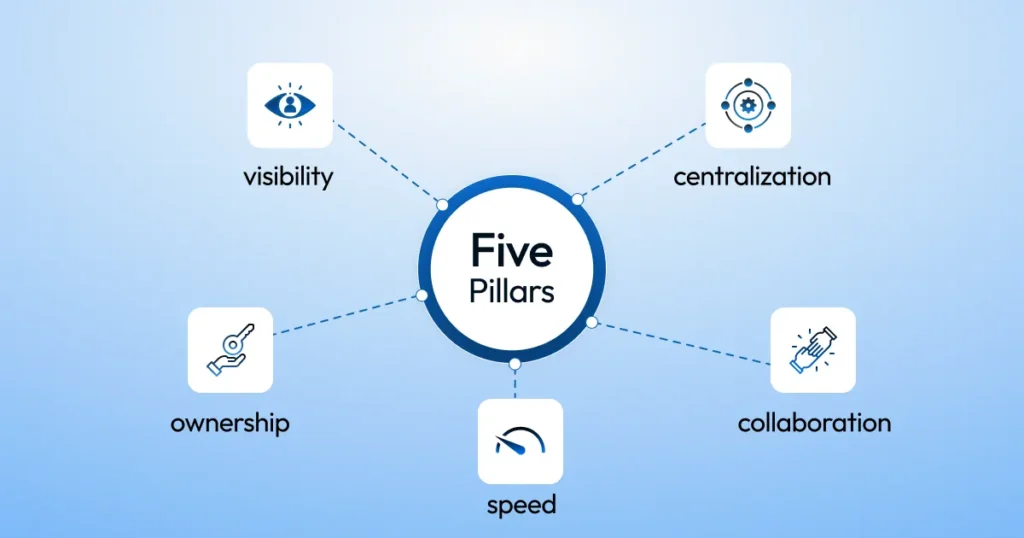
Effective conversation management rests on five essential pillars:
1️⃣ Centralization
All interactions in one place – regardless of channel.
Customer messages you on WhatsApp on Monday, emails Wednesday, and uses live chat on Friday. Your team can see all customer messages together, giving the full picture of the customer’s journey.
This way, nothing gets missed, and agents always know the customer’s history.
2️⃣ Ownership
A clear assignment prevents chaos.
Every interaction has one person responsible. When a new customer inquiry arrives:
● System assigns it automatically based on rules (round-robin, skill-based, etc.)
● Or team member claims it manually
● Everyone else sees “Priya is handling this.”
Benefits:
● Accountability – no “I thought you were handling it.”
● No duplicate replies embarrassing your brand
● No ignored messages costing you deals
3️⃣ Visibility
Managers can see everything in real-time.
Unlike scattered personal inboxes, proper customer conversation management gives managers dashboards showing:
● Which conversations are unanswered
● How long customers have been waiting
● Workload distribution across the team
● Bottlenecks identified early
This enables proactive handling instead of reactive firefighting.
4️⃣ Speed
Track and improve response times.
The probability of connecting is 100 times higher if the response is within 5 minutes compared to a 30-minute wait.
This system’s track:
● First response time
● Average response time
● Resolution time
Faster internal handoffs mean faster customer responses.
5️⃣ Collaboration
Teams work together seamlessly.
Built-in collaboration features enable:
● Internal notes – discuss customer issues privately
● @Mentions – tag teammates who can help
● Context sharing – no forwarding chains or screenshots needed
Agent A starts a conversation, and Agent B continues it later with full context. Customer experiences one seamless interaction.
See how teams collaborate on customer conversations →
Why Customer Conversation Management Impacts Revenue
It helps keep messages in order and also grows your sales.
The conversion rate is higher with fast responses: For every hour of delay, the conversion chance is 8% lower. Customers asking “What’s the price?” will get answers in minutes, not hours.
Customers lose trust with slow responses: If customers have to wait for hours to get answers to live chat or WhatsApp questions, they feel your team is unorganized or doesn’t care. Trust drops. They shop elsewhere. Understanding customer behavior patterns helps teams respond at the right time with the right message.
Missed messages equal lost deals: One missed inquiry from a personal inbox means one lost customer. McKinsey says businesses lose 20–30% of possible revenue because customer messages aren’t managed well.
If customers get confused or have to repeat themselves, they may go to a competitor.
The Revenue Connection
Customer conversation directly impacts:
● Customer lifetime value – Better experiences mean longer customer relationships
● Retention rates – Fast, consistent support keeps customers loyal
● Upsell success – Context about customer needs and customer behavior enables better recommendations
This shifts the conversation from “support efficiency” to “revenue protection and growth.”
How Modern Teams Implement a Conversation Management System
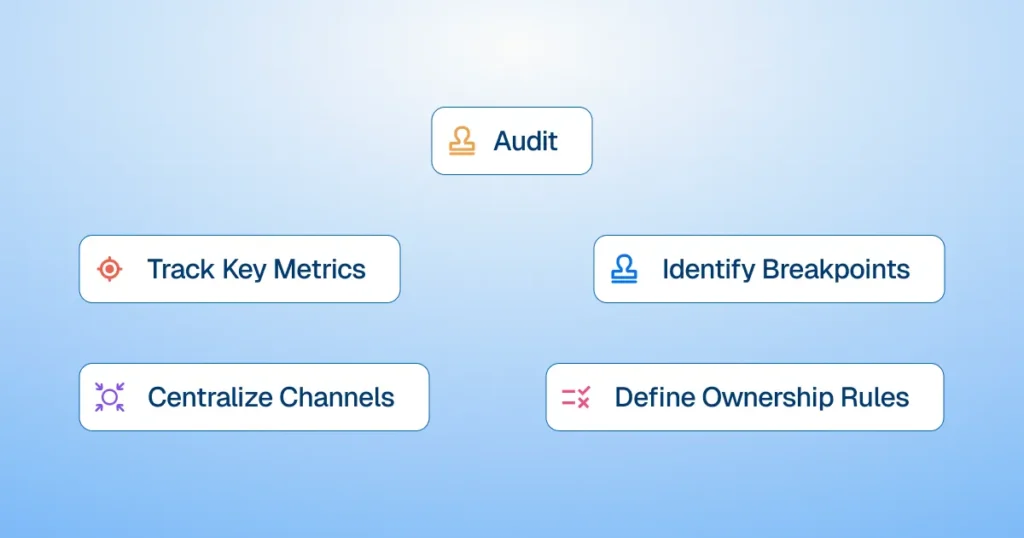
Ready to implement proper conversation management? Here’s the step-by-step process:
Step 1: Audit Current Communication Channels
Ask these questions:
● Where do customer conversations happen? (Email, WhatsApp, chat, social, phone)
● Who currently owns each channel?
● How are conversations being managed today?
● What’s currently breaking?
Document everything. You can’t improve what you don’t measure.
Step 2: Identify Breakpoints
Look for these common problems:
● Missed messages (customers complaining about no response)
● Slow replies (hours or days to respond)
● Duplicate responses (multiple people answering the same inquiry)
● Lost context (customers repeating information)
● Manager blindness (leadership doesn’t know what’s happening)
Step 3: Centralize Channels
Connect all customer communications channels to one platform:
● Email accounts (support@, sales@, info@)
● WhatsApp Business accounts
● Website live chats
● Facebook and Instagram messages
● Any other channels customers use
This multi-channel customer communication management ensures nothing slips through gaps.
Step 4: Define Ownership Rules
Create clear assignment systems:
● Round-robin (next available agent gets next conversation)
● Skill-based (technical questions → technical team)
● VIP routing (high-value customers → senior agents)
● Manual claiming (agents choose which conversations to handle)
Document escalation processes for complex issues.
Step 5: Track Key Metrics
Measure what matters:
● First response time (time from customer message to first reply)
● Average response time (across all messages in conversation)
● Resolution time (time from first message to issue solved)
● Volume per agent (workload distribution)
● Customer satisfaction scores
Set targets and review weekly with your team.
Customer Conversation Management vs Traditional Helpdesk Systems
Many businesses confuse customer conversation with traditional helpdesk software. They’re different.
Traditional Helpdesk Systems:
● Ticket-based – turn conversations into numbered tickets
● Reactive – customers must create tickets to get help
● Often email-only – miss WhatsApp, chat, and social
● Slower – ticket queues add delays
Customer Conversation Management Systems:
● Real-time – conversations happen live, not in queues
● Multi-channel – handle email, WhatsApp, chat, social in one place
● Team collaboration focused – built for multiple people working together
● Designed for speed – minimize delays between customer and resolution
Use a helpdesk: For big companies with complicated support, mostly using email, and needing strict tracking of tickets.
When to use customer conversation management: Modern teams handling high-volume, multi-channel customer communications that need speed and collaboration.
Many businesses use both – helpdesk for formal support tickets, and conversation management for real-time customer interactions.
Signs Your Team Needs Customer Conversation Management
You need a proper conversation management system if:
● You handle 30+ customer messages per day across channels
● Multiple agents reply to customers
● Customer messages live on personal devices or scattered tools
● Managers lack visibility into team performance
● You’re experiencing duplicate or missed responses
● Customers complain about slow replies
● Context gets lost when conversations switch between team members
● You can’t track response times or measure improvement
● Onboarding new team members takes weeks because systems are unclear
If 3 or more apply, poor customer conversation management is costing you money and customers.
The Future of Customer Communication: From Inbox to Infrastructure
Customer conversation management is becoming a key part of business, just like your CRM or accounting system.
Why is this shift happening?
Messaging-first businesses: Customers prefer WhatsApp and chat over phone and email. Gartner predicts that by 2025, 75% of customer service interactions will occur via messaging.
Real-time response expectations: “We’ll reply within 24 hours” no longer satisfies customers. They expect responses within minutes.
Increasing channel complexity: Email was simple. Now you manage WhatsApp, Instagram, Facebook, live chat, SMS, and more. Without proper communication management, complexity becomes chaos.
Conversation data is valuable: Customer messages show problems, ideas, and buying habits. Good management helps you understand what customers need. Smart companies use these messages as an important part of their business.
Smart companies don’t see customer conversation management as a cost. They use it to improve customer relationships and make every interaction better.
Conversations Are Assets, Manage Them Like One
Every interaction drives revenue and trust. Each touchpoint is an opportunity to help, to sell, to build loyalty, or to lose a customer forever.
Scattered messages lead to lost opportunities, frustrated customers, and wasted time. Without proper management, you’re leaving customers feeling unheard and undervalued.
Structured customer conversation management ensures visibility, accountability, speed, and collaboration. It changes messy messages into useful ones and helps make customer relationships stronger.
Stop Losing Customers to Scattered Conversations. Start Winning With Organized Ones.
Modern teams use Airchannel to turn chaos into revenue:
● One workspace for WhatsApp, email, chat, and social – no more channel switching
● Instant assignment – every interaction has a clear owner in seconds
● 5x faster responses – team collaboration that customers never see
● Real-time visibility – managers finally know what’s happening
● Zero missed messages – protect every revenue opportunity
Your interactions are too valuable to leave scattered and unmanaged.
Turn Conversation Chaos Into Revenue – Request a Demo →
No credit card. No setup headache. Just organized conversations and happier customers starting tomorrow.