Why Most Business Messages Fall Flat
Customer communication examples are specific templates or scripts used by businesses to interact with their audience. Effective customer communication examples help resolve issues faster and build brand loyalty. In this guide, we provide 15 real-world examples ranging from welcome emails to AI chatbot greetings that you can copy and use for your business in 2026.
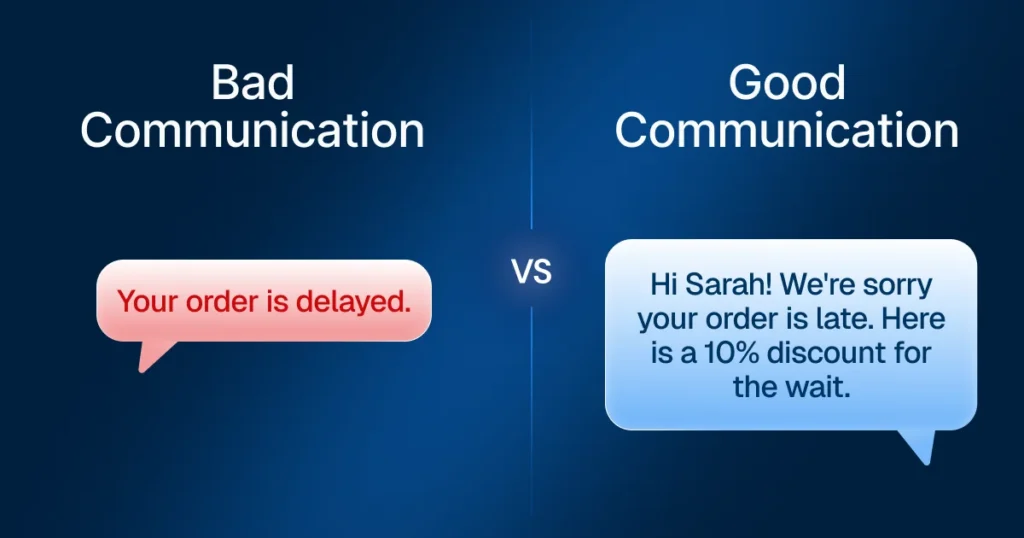
In this post, you will get 15 real scenarios with two versions each. One version shows what most businesses send. The other shows what actually works. Copy the better ones directly into your own workflow.
Before we get into the examples, remember this: the message is only half the equation. Getting the right message on the right channel matters just as much. You can read more about that in our guide to customer communication channels.
The 5 C’s of Great Customer Communication
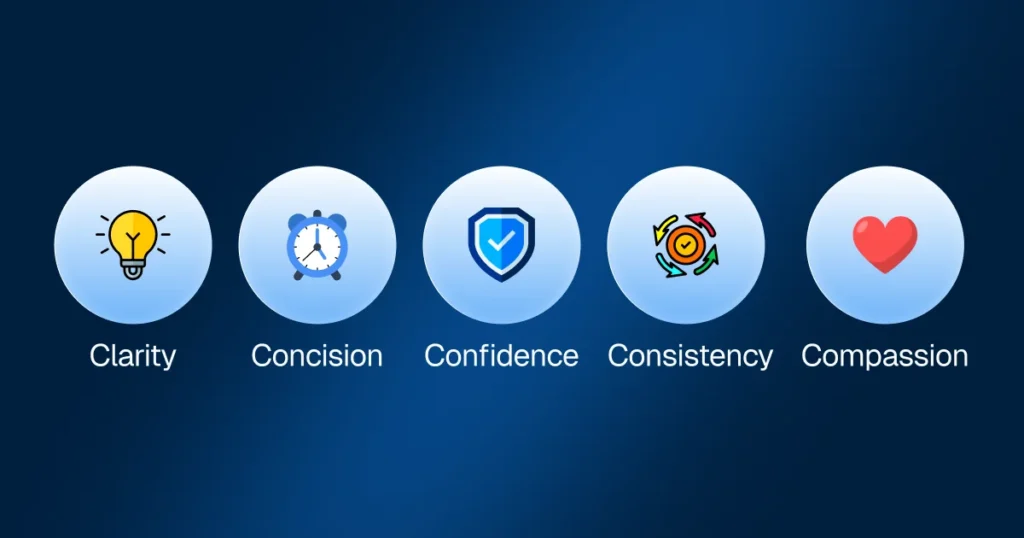
Every great customer message follows five simple rules. Think of these as your quality checklist before hitting send.
Clarity. Say exactly what you mean. No vague language. No “we will look into this.” Tell the customer what is happening and what comes next.
Concision. Keep it short. Customers do not read long messages. If you can say it in two sentences, use two sentences.
Confidence. Sounds like you know what you are doing. Avoid phrases like “I think” or “maybe.” Customers trust confident language.
Consistency. Use the same tone across every channel. Whether a customer reaches you by SMS, email, or chat, the experience should feel like the same brand.
Compassion. Acknowledge how the customer feels before jumping to a solution. People want to feel understood before they want to feel fixed.
15 Customer Communication Examples for 2026
These customer communication examples cover the most common scenarios your team faces every day. Each one includes a bad version and a better version.
1. Welcome Email
Bad Example: “Dear Valued Customer, Thank you for creating an account with us. Please explore our full range of products and services. We look forward to serving your needs.”
Better Example: “Hi [First Name], welcome to [Brand]. Your account is ready. Here is what to do next:
Step 1: Complete your profile (2 minutes)
Step 2: Browse our top picks for new members
Step 3: Reply to this email if you need anything. We are here whenever you need us.”
2. Late Order Apology (SMS)
Bad Example: “Your order has been delayed. We apologize for any inconvenience caused. Please contact support for more information.”
Better Example: “Hi [First Name], your order #[12345] is running late.
New delivery date: [Date]. We are sorry for the wait.
Reply HELP if you need anything or want a refund. [Brand]”
3. Website Chatbot Greeting (AI)
Bad Example: “Hello! I am a virtual assistant. How may I assist you today? Please select from the following options: 1. Orders 2. Returns 3. Account 4. Other.”
Better Example: “Hey there! I am [Bot Name], and I can help you in about 30 seconds. What do you need today? Orders, returns, or something else?”
4. Order Confirmation (Email)
Bad Example: “This email confirms that your order has been received and is being processed. You will receive further communication when your order has been dispatched.”
Better Example: “Your order is confirmed, [First Name].
Order number: #[12345]
Estimated delivery: [Date]
We will text you when it ships. Questions? Just reply here.”
5. Requesting a Product Review (WhatsApp)
Bad Example: “Dear Customer, we would appreciate it if you could take a moment to leave us a review for your recent purchase. Your feedback is important to us.”
Better Example: “Hi [First Name]! Hope you are loving your [Product]. Got 30 seconds? A quick review helps others find us. Here is your link: [Link]. Thanks so much! [Brand]”
6. Escalating to a Human (AI Handoff)
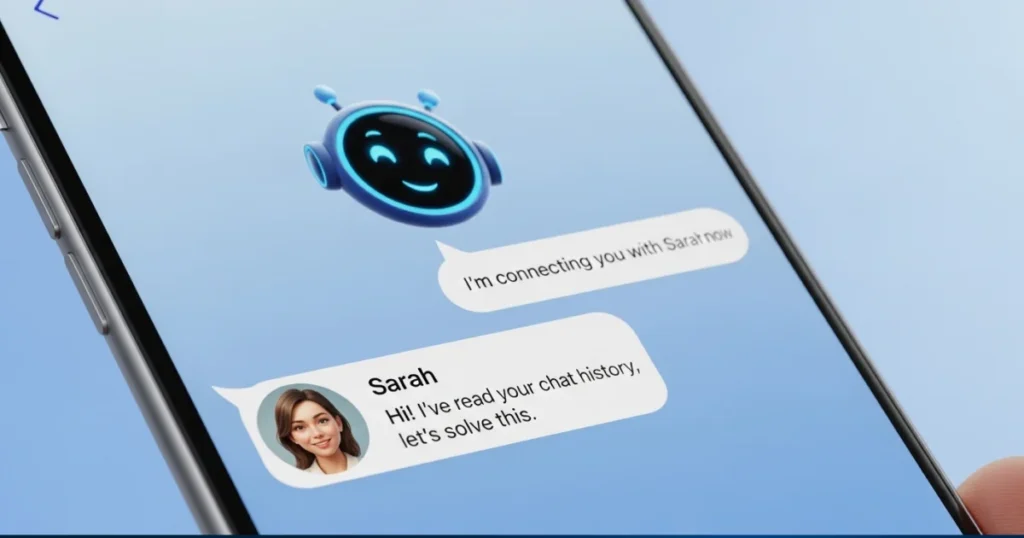
Bad Example: “I am unable to assist with this. Transferring to the agent.”
Better Example: “I want to make sure you get the best help here. I am connecting you with [Agent Name] right now. They already have your details, so you will not need to repeat anything. One moment!”
7. Booking a Weekly Cadence Call (Video)
Bad Example: “Please schedule a call with your account manager at your convenience using the link below.”
Better Example: “Hi [First Name], let us lock in our weekly 30-minute call. These sessions are for you. We cover wins, blockers, and what is coming next. Pick a time here: [Link]. See you soon!”
8. Handling a Complaint (Email)
Bad Example: “We have received your complaint and will investigate the matter. Please allow 5 to 7 business days for a response.”
Better Example: “Hi [First Name], I am sorry this happened. That is not the experience we want for you. Here is what I am doing right now: [Specific Action]. I will update you by [Date]. If you need me sooner, reply here or call [Number].”
9. Payment Failed Notification (SMS)
Bad Example: “Your payment has failed. Please update your billing information to avoid service interruption.”
Better Example: “Hi [First Name], your payment did not go through. No stress, it happens! Fix it here in 60 seconds: [Link]. Need help? Reply, and we will sort it. [Brand]”
10. Subscription Renewal Reminder (Email)
Bad Example: “This is a reminder that your subscription will renew on [Date]. Please ensure your payment details are up to date.”
Better Example: “Hi [First Name], your [Plan Name] renews on [Date] for [Amount]. Nothing to do if everything looks good. Want to upgrade, downgrade, or cancel? Do it here: [Link]. We are also happy to chat if you have questions.”
11. Refund Confirmation (Email)
Bad Example: “Your refund request has been approved. Please allow 5 to 10 business days for the funds to appear in your account.”
Better Example: “Good news, [First Name]. Your refund of [Amount] is on its way. It should hit your account by [Date]. Sorry for the trouble. We hope to see you again. If anything else comes up, we are here.”
12. Proactive Outage Alert (SMS)
Bad Example: “We are currently experiencing a technical issue. Our team is working to resolve this as soon as possible. We apologize for any inconvenience.”
Better Example: “Hi [First Name], heads up. [Service] is down right now. Our team is on it. Expected fix: [Time]. We will text you the moment it is back. Sorry for the disruption. [Brand]”
13. Re-engagement Message (Email)
Bad Example: “We noticed you have not logged in recently. We miss you! Come back and explore what is new.”
Better Example: “Hi [First Name], it has been a while, and we noticed. A lot has changed since you last visited: [2 to 3 specific updates]. Come back and see what is new: [Link]. If something put you off, tell us. We read every reply.”
14. Post-Call Follow-Up (Email)
Bad Example: “Thank you for speaking with us today. Please do not hesitate to reach out if you require further assistance.”
Better Example: “Hi [First Name], great talking today.
Here is what we agreed on:
[Action 1] by [Date] [Action 2] by [Date] I will check in on [Date]. Reply anytime if something comes up.”
15. Loyalty Reward Notification (SMS)
Bad Example: “Congratulations. You have earned loyalty points. Log in to view your rewards balance.”
Better Example: “You just earned [X] points, [First Name]!
You are [X points] away from a free [Reward].
Check your balance here: [Link].
Nice work! [Brand]”
Bad vs. Better at a Glance
Here is a summary of the most common customer communication examples and what separates a weak message from a strong one.
| Scenario | What Makes It Bad | What Makes It Better |
| Welcome Email | Generic, no next step | Personal, action-oriented, clear |
| Late Order Apology | Vague, cold, no ownership | Specific date, apology, easy reply option |
| Chatbot Greeting | Robotic, menu-heavy | Friendly, fast, feels human |
| Product Review Request | Formal, feels like a mass blast | Short, personal, low-effort ask |
| AI Handoff | No context, abrupt | Feels like a partnership |
| Weekly Cadence Call | Feels like admin | Reassuring, specific, leaves the door open |
| Complaint Response | Delays, no detail | Immediate action, specific timeline |
| Payment Failed | Threatening tone | Calm, helpful, easy fix |
| Refund Confirmation | Cold, uncertain | Specific updates, invite feedback |
| Re-engagement | Vague and generic | Specific updates, invites feedback |
How Airchannel.ai Helps You Send Better Messages at Scale
Writing better messages is one thing. Sending them at the right time, on the right channel, to thousands of customers at once is another challenge entirely.
That is where Airchannel.ai comes in.
Airchannel.ai is built to help businesses automate the exact customer communication examples in this post, while keeping the tone warm and human. Here is what it does:
Automated message personalization. Airchannel.ai pulls in customer data like names, order numbers, and past interactions so every message feels one-to-one, even when you are sending at scale.
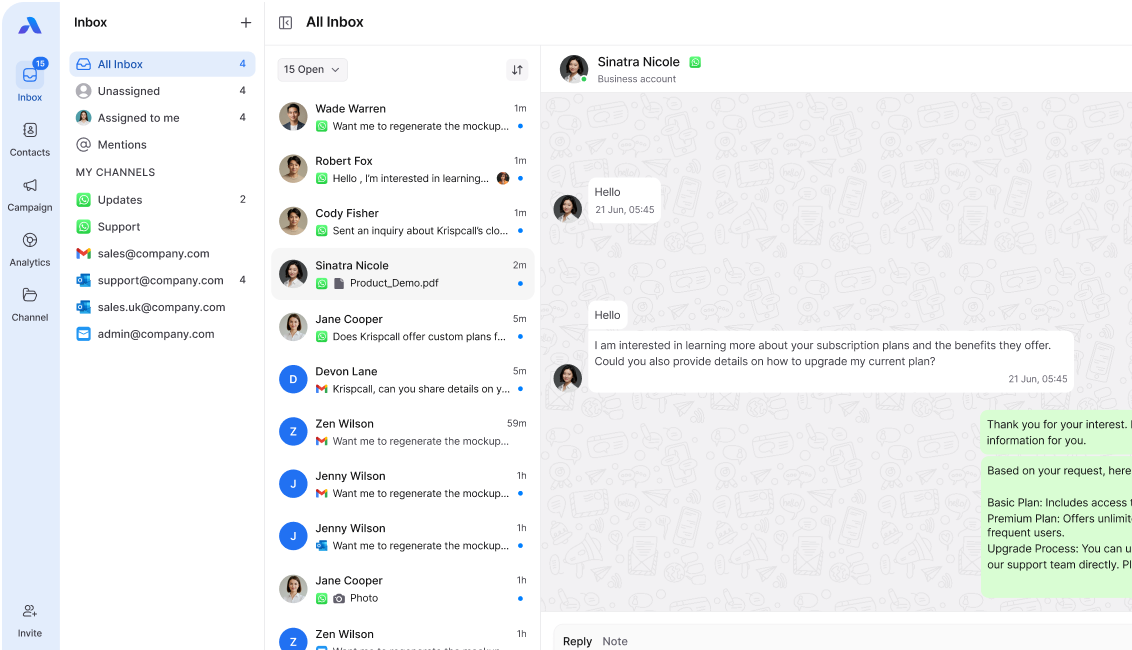
Omnichannel delivery. Whether the message belongs on SMS, WhatsApp, email, or live chat, Airchannel routes it to the right channel based on customer behavior and preferences.
AI tone monitoring. The platform checks your message drafts against tone guidelines before they go out. This keeps every message on-brand and in line with the 5 C’s covered above.
Smart escalation triggers. When a bot cannot handle a conversation, Airchannel.ai hands off to a human agent with full context attached. No more customers repeating themselves.
Template library. Store your best-performing versions of the customer communication examples above directly in the platform. Your whole team uses the same proven scripts.
The result is a support operation that feels personal to every customer, without burning out your team.
Final Thoughts
The gap between a bad message and a better one is rarely about budget or team size. It is almost always about intention.
Bad messages are written for the business. Better messages are written for the customer.
Every time you send a message, ask yourself: Does this make the customer’s life easier? Does it answer their question before they have to ask it? Does it sound like a human being wrote it?
If the answer is yes, you are already ahead of most businesses out there.
The 15 customer communication examples in this post are a starting point. Adapt them, test them, and make them your own. And remember, picking the right words only works when you have also picked the right channel. Check out our full guide to customer communication channels to make sure your messages are landing in the right place.
Future-Proof Your Customer Communication for 2026
Ready to move from reactive replies to proactive engagement? Build a communication strategy that your customers will love.
Book a Demo with Airchannel.ai Today.